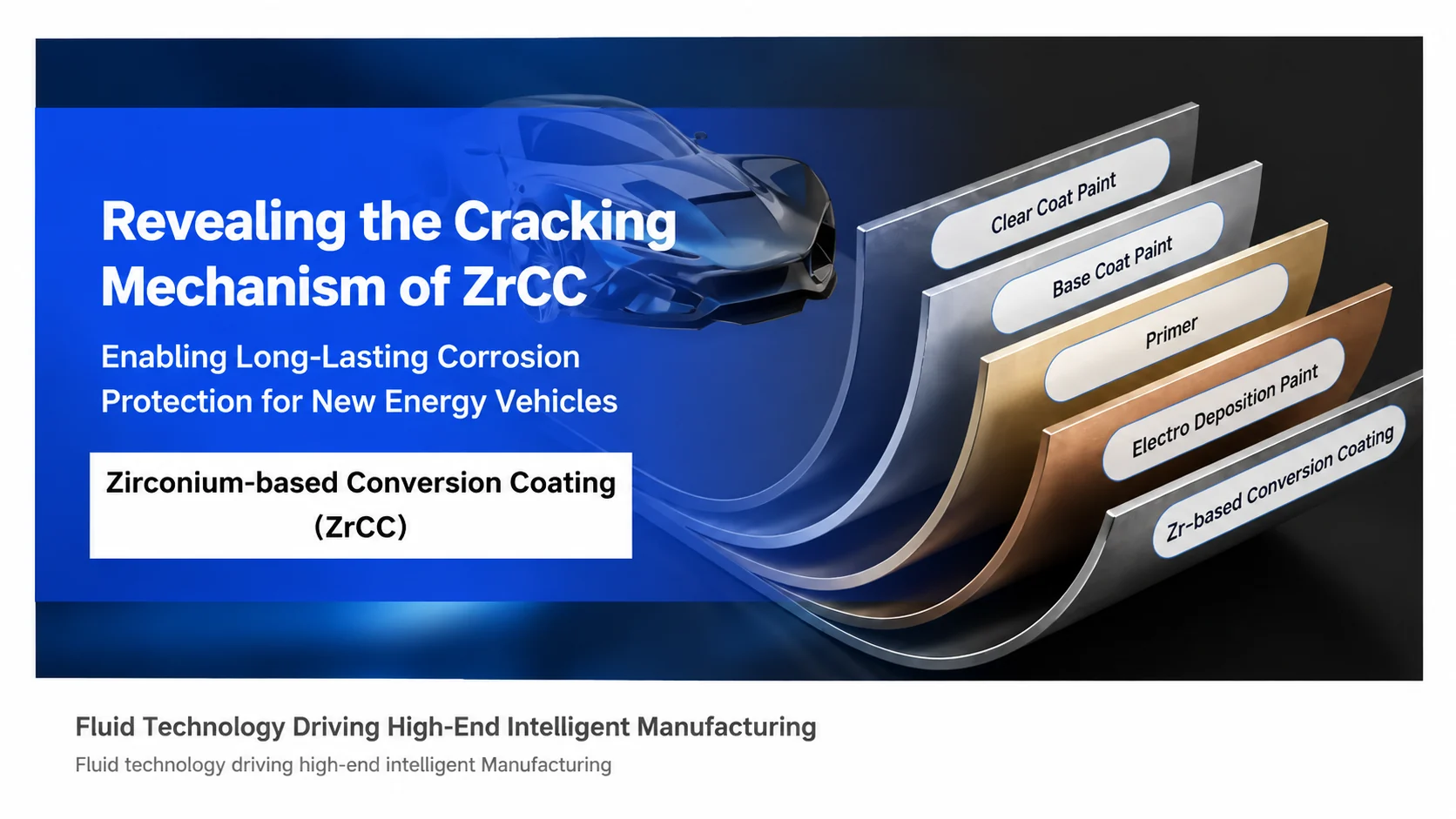
Zirconium-based conversion coatings (ZrCCs) have emerged as one of the most promising technologies in metal surface treatment in recent years. Owing to their environmentally friendly characteristics—being free of heavy metals and phosphates—ZrCCs have been widely commercialized across the global automotive industry. However, during co-curing with electrophoretic coatings (typically involving heat treatment at 140–180°C), ZrCCs are prone to cracking and even delamination, posing risks to the adhesion and corrosion resistance of automotive multilayer coating systems. This phenomenon has become a critical bottleneck limiting the long-term protective performance of ZrCCs, and its underlying mechanism has remained controversial.
Recently, the Kerun Industrial Media Research Institute, in collaboration with Professor Feng Xue’s research team from the School of Materials Science and Engineering at Southeast University, as well as researchers from Nanjing Institute of Technology and other institutions, conducted a systematic investigation into the cracking behavior of ZrCCs formed on various automotive metals, including steel and aluminum alloys. By employing a multimodal approach to simulate automotive coating processes, the team explored the issue from a novel perspective—the water content within ZrCCs—and comprehensively revealed the dehydration-driven mechanism responsible for thermally induced cracking.
The latest findings, entitled “Clarifying the Cracking Behavior and Crack Suppression of Zr-Based Conversion Coatings on AA6016 Al Alloy,” were published in Corrosion Science, a leading journal in the field of corrosion science.
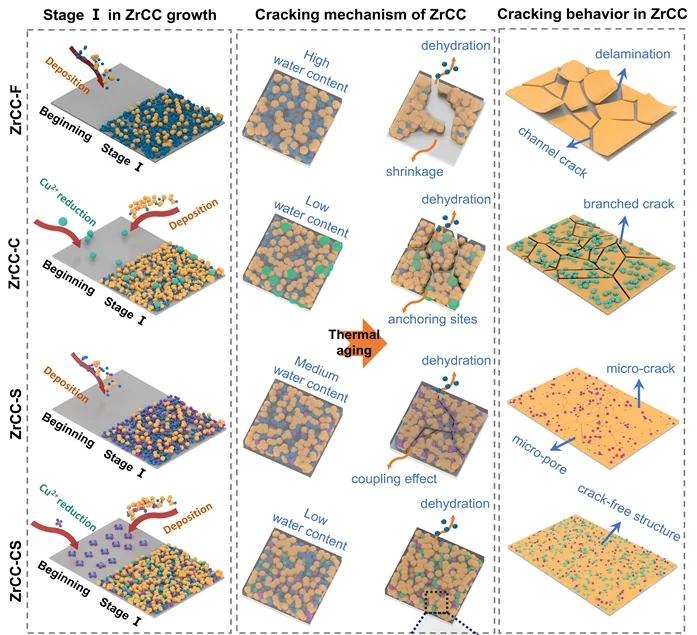
Figure 1. Schematic Illustration of the Thermal Aging Cracking Mechanism of ZrCCs
Using AA6016-T4 aluminum alloy as the substrate, the researchers designed four different conversion-coating formulations. Three thermal-aging protocols were employed to simulate automotive coating processes, enabling a comparative analysis of the morphological and structural evolution of ZrCC films.
Before thermal aging, all four ZrCCs formed continuous and uniform surface coverage. Among them, the ZrCC-CS coating exhibited highly dispersed Cu@ZrO₂ core–shell particles, with a well-defined and defect-free coating/substrate interface.
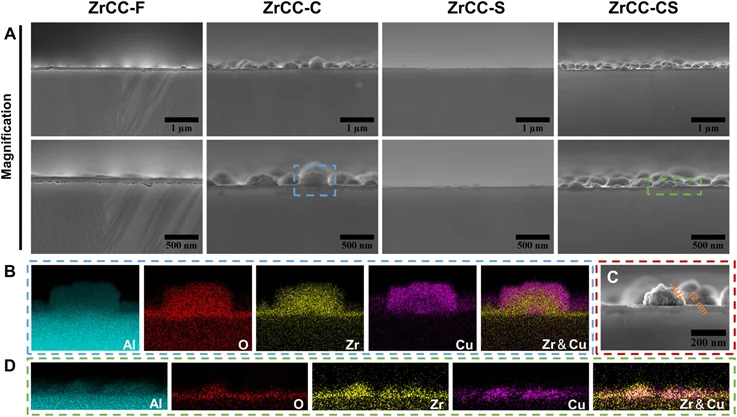
Figure 2.(A) Cross-sectional morphology of ZrCCs;(B) Elemental mapping of a local region in ZrCC-C;(C) High-magnification morphology of surface particles in ZrCC-CS;(D) Elemental mapping of a local region in ZrCC-CS.
Three thermal-aging experiments were conducted:
Direct baking at 180°C to simulate electrophoretic coating curing;
Stepwise heating at 100°C followed by 180°C to simulate industrial drying processes;
Electrophoretic coating curing followed by coating removal to simulate the complete automotive painting process.
All three experiments produced consistent results:
ZrCC-F underwent severe volumetric shrinkage, resulting in extensive network-like cracking and localized delamination.
Modification with a single additive could partially alleviate cracking but still led to microcrack formation and reduced interfacial adhesion.
ZrCC-CS maintained structural integrity before and after thermal aging, with adhesion to both the metallic substrate and electrophoretic coating improving by more than 40% compared with ZrCC-F.
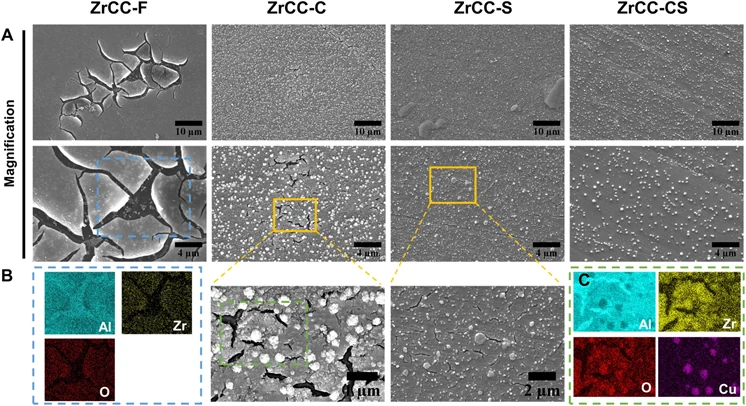
Figure 3.(A) Surface morphologies of ZrCCs after direct thermal aging;(B) Elemental mapping of the blue dashed region in ZrCC-F;(C) Elemental mapping of the green dashed region in ZrCC-C.
After thermal aging, all coatings except ZrCC-CS exhibited dual time-constant characteristics due to crack formation, accompanied by a significant decrease in impedance modulus. The decline in polarization resistance was most pronounced for ZrCC-F.
Scanning Vibrating Electrode Technique (SVET) current mapping further confirmed the presence of multiple highly active localized corrosion sites on the ZrCC-F surface. These sites corresponded to exposed substrate regions at crack locations, where corrosive media could penetrate the coating. In contrast, ZrCC-CS displayed no significant localized corrosion signals, indicating that its intact structure effectively blocked corrosion pathways and maintained long-term protective performance.
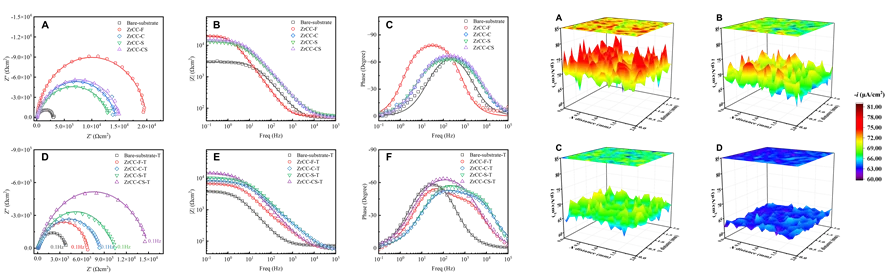
Figure 4.Left: Electrochemical Impedance Spectroscopy (EIS) data of different ZrCCs in 0.1 M Na₂SO₄ solution:(A–C) Nyquist and Bode plots before thermal aging;(D–F) Nyquist and Bode plots after thermal aging.
Figure 5.Right: Three-dimensional SVET current-density distribution of different ZrCCs after thermal aging:(A) ZrCC-F-T;(B) ZrCC-C-T;(C) ZrCC-S-T;(D) ZrCC-CS-T.
The researchers found that during thermal aging, the ZrCC samples exhibited typical dehydration characteristics of zirconium hydroxide. The total weight loss of ZrCC-F reached 42%, whereas that of ZrCC-CS was only 31%.
Through a coupled analysis of interfacial reaction thermodynamics and coating-growth kinetics, the team further elucidated the mechanism governing bound water in ZrCCs. During the corrosion activation stage, Zr⁴⁺ coordination intermediates underwent burst nucleation via the LaMer mechanism, followed by rapid condensation into hydroxyl-linked and oxygen-bridged structures.
The rapid increase in interfacial pH accelerated the nucleation and condensation of zirconium sol particles, entrapping substantial amounts of bound water within colloidal particles and resulting in a low-crystallinity, hydroxyl-rich open network structure. By promoting a better balance between anodic dissolution and cathodic deposition, ZrCC-CS effectively reduced the bound-water content within the conversion coating.
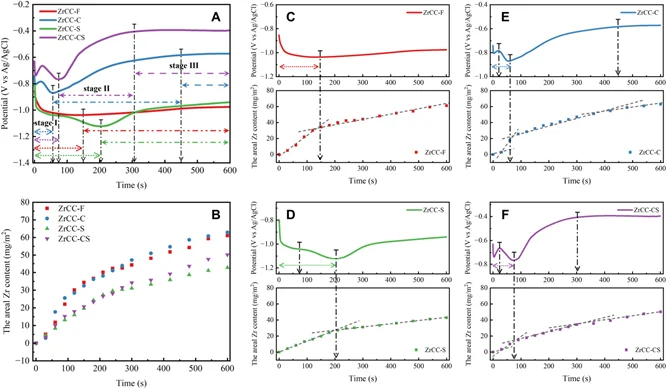
Figure 6.Growth-kinetics analysis of ZrCC samples:(A) Open-circuit potential (OCP) data;(B) ZrCC deposition rate;(C–F) Coupled analysis of OCP and ZrCC deposition rate.
Compared with ZrCC-F, the unique interfacial electronic structure of ZrCC-CS enhanced the cohesive strength of the conversion coating, thereby improving its resistance to thermal aging.
UV–Vis diffuse reflectance spectroscopy (UV–Vis DRS) further supported these findings. Both ZrCC-C and ZrCC-CS exhibited broad absorption bands in the 450–700 nm range, attributed to the localized surface plasmon resonance (LSPR) effect of copper particles. This observation indicates the formation of a denser and more integrated Cu/ZrO₂ interfacial structure within the conversion coating.
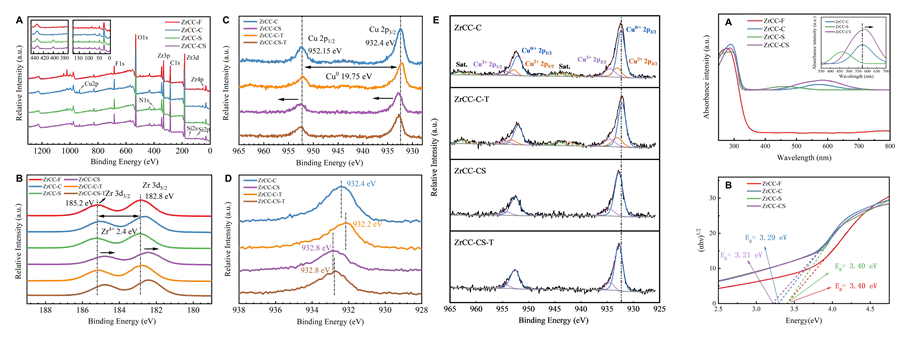
Figure 7.Left: XPS spectra of different ZrCC samples:(A) Survey spectra;(B) Zr 3d;(C) Cu 2p;(D) High-resolution Cu 2p₃/₂ spectra;(E) Cu 2p peak fitting.
Figure 8.Right:(A) UV–Vis DRS spectra of different ZrCC samples;(B) Optical band-gap determination.
The study demonstrates that the fundamental cause of thermally induced cracking in ZrCCs is volumetric shrinkage resulting from the removal of bound water. This phenomenon can occur during both direct thermal aging and indirect thermal aging beneath electrophoretic coatings, ultimately compromising the protective performance of multilayer coating systems.
To address this challenge, the researchers innovatively proposed a dual crack-suppression strategy:
Regulating coating-growth kinetics to reduce water content within the coating;
Reconstructing the coating structure to enhance cohesive strength.
Future research will extend this work to multi-metal systems involving zinc and magnesium alloys, broader temperature windows, and long-term performance evaluations.
The paper’s first author is Dr. Dali Wei from the Kerun Industrial Media Research Institute. Corresponding authors include Associate Professor Jing Bai, Mr. Cheng Wang from the School of Materials Science and Engineering at Southeast University, and Mr. Qiangsheng Dong from Nanjing Institute of Technology.
About Nanjing Kerun
Nanjing Kerun Industrial Media Co., Ltd. (Stock Code: 835906) is a national-level specialized and innovative “Little Giant” enterprise focusing on the research, development, production, sales, and technical services of industrial media throughout the metal-processing value chain.
The company provides integrated solutions covering:
Heat-treatment quenching media
Metalworking and forming fluids
Environmentally friendly surface-treatment chemicals
High-performance steel rolling media
Complete processing equipment systems
In the field of green surface treatment, the Kerun Industrial Media Research Institute continues to focus on surface-treatment and corrosion-protection technologies for multi-metal systems used in new energy vehicles, including steel, zinc, aluminum, and magnesium alloys, striving to deliver more efficient and environmentally sustainable solutions to the industry.
Paper DOI: https://doi.org/10.1016/j.corsci.2026.113826